5 August 2026
What is the pitanga fruit?
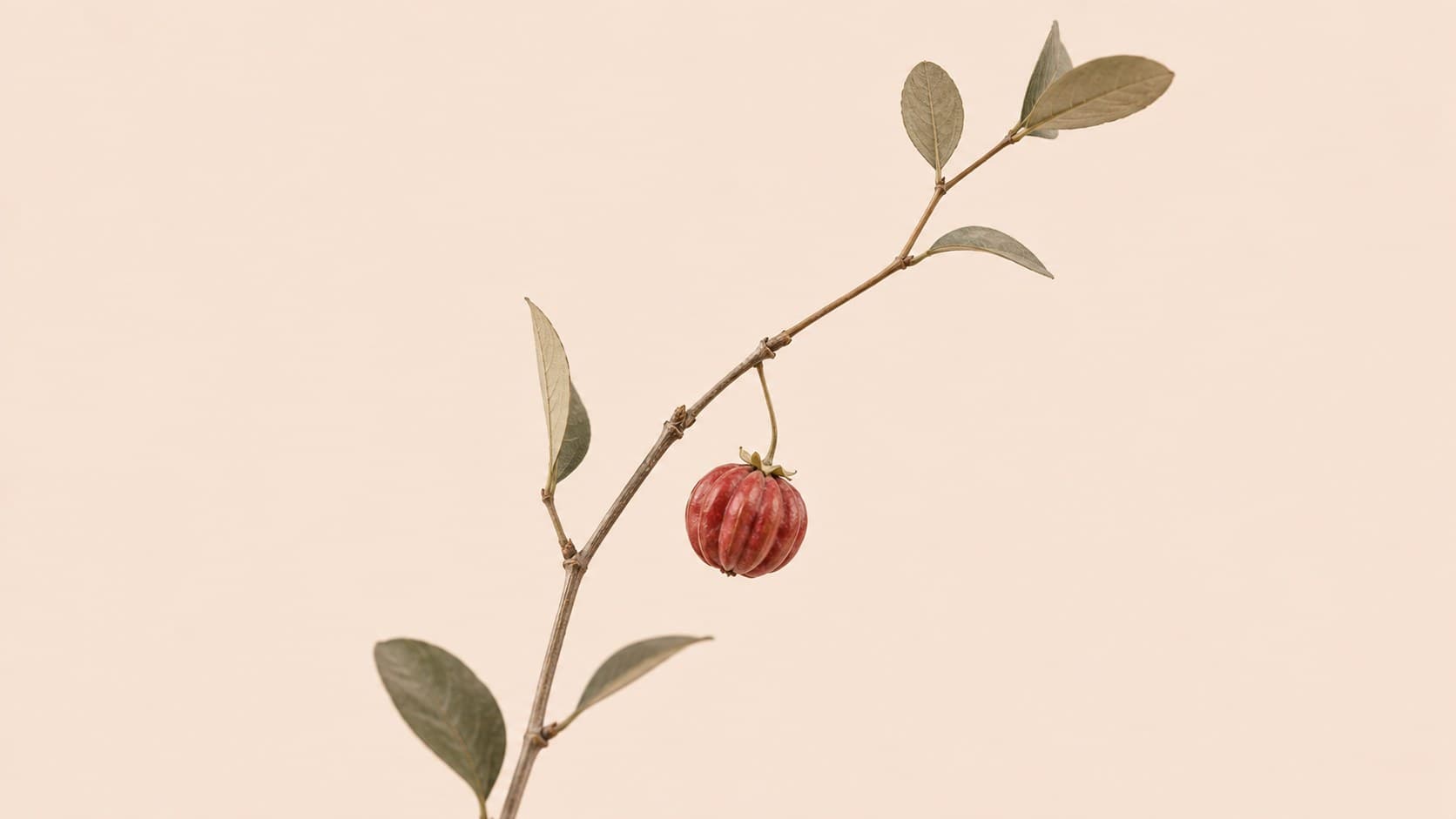
The pitanga fruit comes from Eugenia uniflora, a small tree in the myrtle family. In English it is called the Surinam cherry - sometimes Brazilian cherry or Cayenne cherry. Its own name is older than any of the English ones: it comes from the Tupi word ybapytanga, "reddish fruit". The fruit earns it - a deeply ribbed berry, two to four centimetres across, that ripens from green through orange and scarlet to a dark, almost black red.
It is also one of the botanicals in Canning's Dry Gin, distilled on Madeira, where the pitanga tree grows in gardens across the island. Its bright, delicately tart character runs alongside passion fruit over a base of juniper.
What does pitanga taste like?
Bright and delicately tart, and it changes with colour. Picked in the green-to-orange range the fruit is strikingly sharp; left to ripen to dark red or near-black, it turns properly sweet. Between the two sit red-fruit sweetness, a clean acidity and a faint resinous edge that stops it short of sugary.
That resinous streak is in the tree itself: crush a pitanga leaf and it releases a spicy, resinous scent. This is what interests distillers. In a spirit, pitanga reads as freshness and character rather than jam.
Where does pitanga grow?
The tree is native to the Atlantic coast of South America, from Suriname and French Guiana down through southern Brazil to Uruguay, Paraguay and northern Argentina. In Brazil it belongs to the Mata Atlântica, the old coastal forest. From there it spread widely, and today it also grows on Madeira, where the subtropical climate suits it and it keeps company with passion fruit, the island's other signature fruit.
What it never became is a supermarket fruit. Ripe pitanga is soft and fragile and does not survive transport, so there is no real commercial crop anywhere. It stayed a garden fruit: grown from a single stone in backyards, clipped into hedges, content in almost any soil, sandy ground by the sea included. If you have ever eaten one, it almost certainly came off somebody's tree.
The tree behind the fruit
Eugenia uniflora is a slow-growing shrub or small tree, usually two to four metres tall and up to eight in good conditions. New leaves come in bronze and copper before deepening to glossy green; the flowers are small and white, four petals around a puff of stamens, and well loved by bees.
People have always found uses for it beyond the fruit. In parts of Brazil the crushed leaves are scattered on floors to keep flies away; in Uruguay they are brewed as a tea. The fruit itself is rich in vitamin C and, where it grows, goes mostly into jams and juices - when it is not eaten straight off the branch.
Pitanga in Canning's gin
Canning's Dry Gin is distilled in small batches in Ribeira Brava, on the island of Madeira, and pitanga is one of its botanicals - alongside mountain juniper, plants native to the Laurissilva laurel forest (a UNESCO World Heritage Site), passion fruit and pure mountain water. It is bottled at 40% vol. Madeira is one of the places gin is made in Portugal; the Portuguese gin guide covers the others.
A fruit too delicate to ship is a good reason to distil where it grows. In the glass the juniper leads and the island fruit follows: passion fruit carries the tropical note, pitanga the lively, sharper one, over a slightly earthy base and a long, soft finish. The gin took a Gold Medal at the International Wine & Spirit Competition in 2018. What makes it a Madeira gin has a page of its own.
How to taste pitanga in a gin and tonic
Pour one part Canning's to three parts of your favourite tonic over plenty of ice, with lime zest and a sprig of mint. Let it sit a moment, then look past the juniper for the bright red-fruit note. That is the pitanga, with the passion fruit beside it.
The same character carries into the pitanga cocktails and the cocktail recipes, which lean on the island fruit rather than covering it up.